First settle which material you mean
| Name | What it actually is | Role in a recipe |
|---|---|---|
| Potato starch | starch washed out of the tuber | thickening and stabilising; neutral in taste and smell |
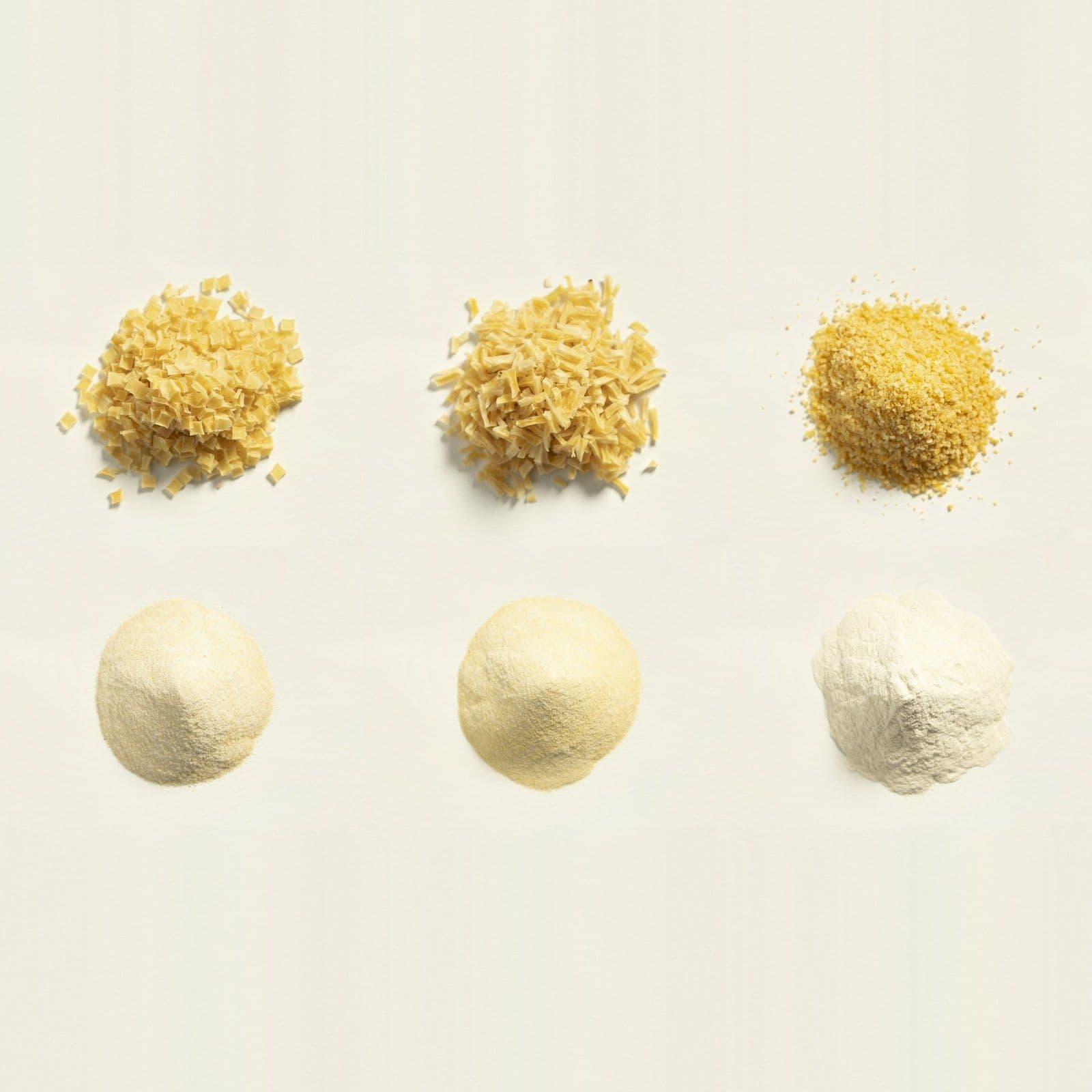
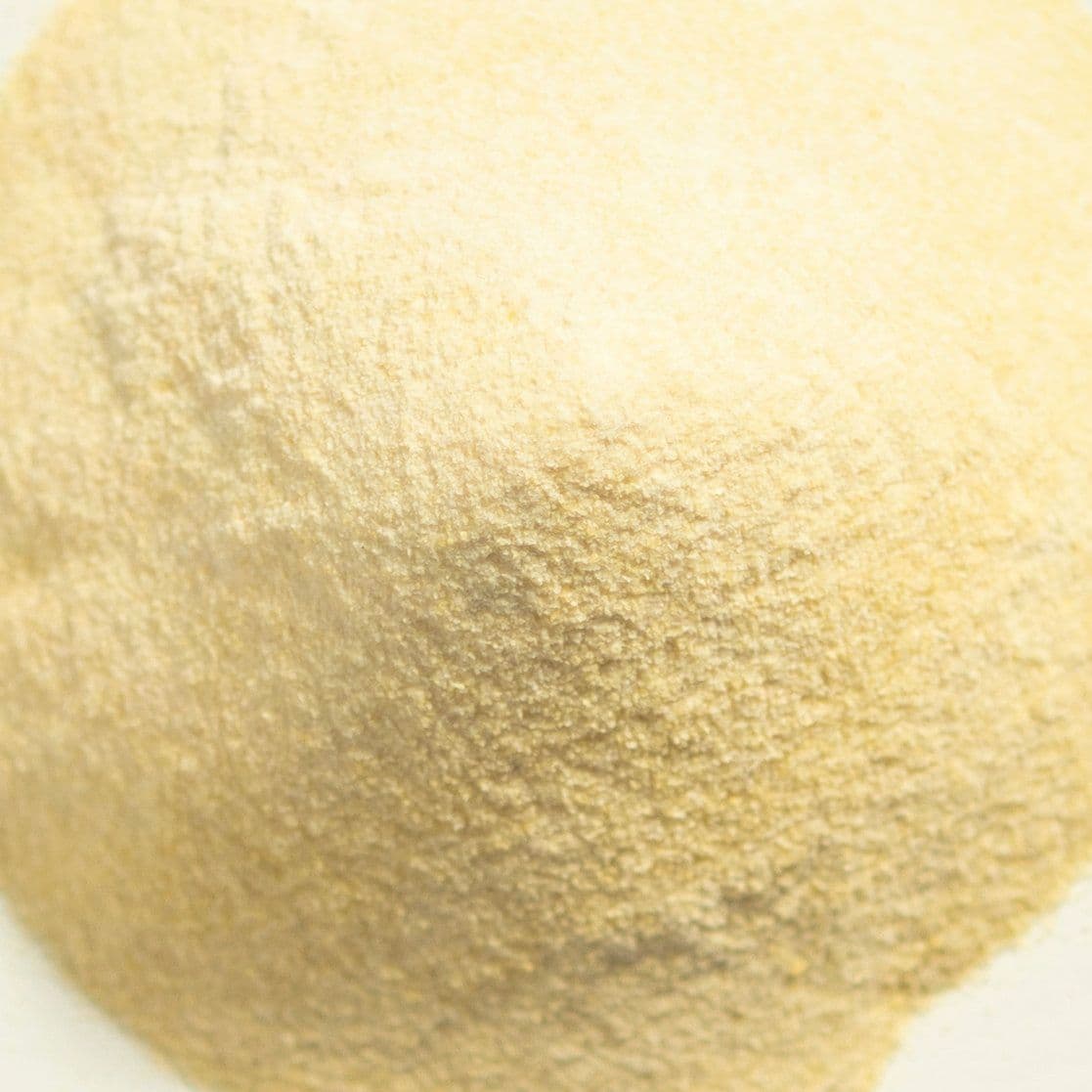
| Potato flour | dried whole potato milled to 0.01-0.5 mm | base for masses, water binding, potato flavour and aroma |
| Potato flakes | potato cooked, mashed and drum-dried | base for mash and masses |
That distinction drives the whole choice of material. Starch is an isolated component: white, neutral in taste and smell. Dried potato is the whole potato without the water - starch, protein and fibre together, with one entry on the label: 100% dried potato (Solanum tuberosum), with no preservatives, emulsifiers or SO₂. The full comparison of names and compositions is in Potato flour vs potato starch.
So the first question we ask in reply to an enquiry about "potato flour" is always the same: starch or milled dried potato? The answer changes the whole conversation - and it, not a price list, decides whether we have anything to offer.
If what you need is starch
Where a recipe needs thickening, clarity and a neutral taste, the substitute for potato starch is another starch - and that is a material we do not sell. We do one thing, and the range is potato only, as dehydrated forms and instant mixes; dried potato is not starch and does not pretend to be.
It is worth knowing straight away, because swapping starch for dried potato "one for one" will not work where the material's only job is to thicken without adding flavour. In a sauce where the starch was meant to be invisible, dried potato will be noticeable - not a fault, just a different function.
If what you need is potato rather than starch
This is where our product is the right replacement. Three typical situations:
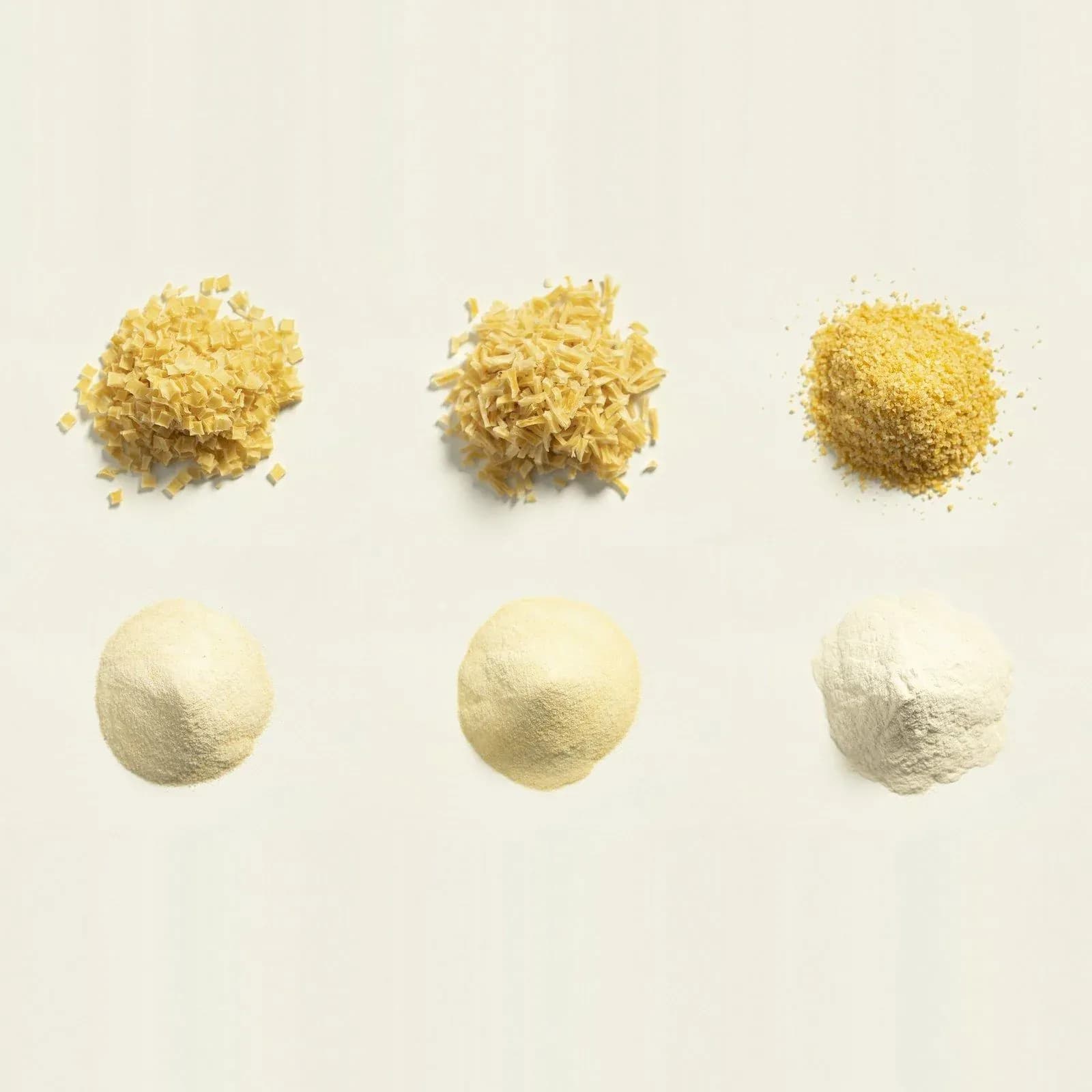
- Replacing potato flakes. Potato powder and potato granules go in place of flakes in the same quantity, at the same dosing stage, with only the water adjusted. Granules bind water indicatively up to 1:4.5 - 1 kg and 4.5 l of water give about 5.5 kg of product, while for flakes in the example analysed 1 kg and 4 l gave about 5 kg.
- Thickening with flavour. Powder and potato semolina bind water in sauces, fillings and masses, and on the label they are one entry - potato. That is the usual choice when starch thickened well but the ingredient list had to get shorter.
- A base for masses and products. Doughs for dumplings, noodles and gnocchi work with semolina at 0.01-1 mm or powder up to 0.5 mm; the full selection table is on the dumplings and gnocchi page.
In each case the fraction is confirmed by a technologist in a trial, and when the choice is close we send two neighbouring fractions for the same recipe. Samples are free once agreed with sales, dispatched within at most 5 working days.
What changes on the label
Changing the material is usually a technological decision, but the result shows on the label - and that is often why the conversation starts at all.
Potato starch appears in a composition as "potato starch". Milled dried potato appears as "potato", because that is what it is: the whole tuber without water, milled into fractions. In products with a short ingredient list that a customer reads, the difference often matters more than the technical function.
The second change concerns documentation. In the dehydrated line the recipe contains no allergens from Annex II to Regulation (EU) No 1169/2011, SO₂ is not added in any line, and the allergen status of a specific item is confirmed by its specification. Every delivery comes with a certificate of analysis, and the plant in Przykona holds an IFS Food certificate at Higher Level covering granule production and packing. For organic recipes there is an organic variant certified by TÜV Rheinland Polska under Regulation (EU) 2018/848. A separate guide covers Storing dehydrated potatoes.
How to ask so you get the right material
An enquiry that can be handled immediately contains four things - and none of them is a trade name:
- What the material has to do in the recipe: thicken, bind water, act as the base of a mass, leave a visible speck.
- What you use today: starch, flakes, boiled potato.
- Whether potato flavour is wanted or in the way. That one sentence usually saves a trial.
- How you dose: gravimetrically or volumetrically - the latter needs the bulk density of the fraction (powder 0.01-0.5 mm is 930 g/l, 0.1-0.5 mm is 825 g/l).
If those four points show that what you need is starch, we will say so plainly - just as we say when dried potato is the wrong choice, for instance when the lowest price per kilogram of raw material is the only criterion.
Frequently asked questions
Instead of potato flour you can use milled dehydrated potato: powder of 0.01-0.5 mm where the mass should be smooth, semolina of 0.01-1 mm where a grain may stay noticeable. Both have one entry in the composition: potato. If what you actually need is an isolated starch and a neutral taste, that is a different material and we do not sell it.
No. Regular flour is milled cereal grain and carries gluten-forming proteins; potato flour is dried whole potato milled to 0.01-0.5 mm, with potato as the label entry. It does not build a gluten network, so it does not replace wheat flour one for one in a dough. In a recipe it binds water and brings potato flavour, and the share is set in a trial.
No. Cornstarch is starch washed out of maize, an isolated component with a neutral taste. Potato flour in our sense is dried whole potato, milled, so the label entry is potato rather than starch. They behave differently in a recipe: the starch forms a clear gel, the milled dried potato binds water and brings flavour and aroma at the same time.
It depends on what the ingredient does in the recipe. Where it works purely as a thickener and the taste should stay neutral, a starch is the closer match, and we do not sell that. Where the ingredient may bring potato flavour and should be one entry on the label, potato powder or semolina is the route, with the amount confirmed in a trial.
If you mean starch and a neutral taste matters, another starch is the answer, and we do not sell it. If the thickener may bring potato flavour and should be one entry on the label, potato powder or semolina does the job: it binds water, builds body and keeps the declaration at potato. The dosage is set with a technologist in a trial on your own recipe.
Yes. Powder and granules go in place of flakes in the same quantity, at the same dosing stage and with no process change; after the first trial the water is adjusted. Granules bind water up to roughly 1:4.5, so 1 kg plus 4.5 l gives about 5.5 kg of mass. The 1:1 replacement trial protocol is available in Downloads.
A smooth mass and a flake swap call for powder up to 0.5 mm; a mass with a noticeable grain calls for semolina at 0.01-1 mm; extrusion calls for granules. For bread, seasonings and coatings the coarse grits of 1.5-2.5 mm are the usual choice. The final decision is confirmed by a technologist in a trial, usually with two fractions sent on the same recipe.
Industrially it is the opposite order from flakes: the potato is cut, dried and only then milled into fractions, with no cooking before drying, which is why the composition stays at one item. Reproducing that in a kitchen will not hold the particle size or the moisture, and for production those two are the point. Constant fraction and batch documentation are what a recipe needs.
Describe what the material has to do in your recipe - request a free sample of two fractions and compare them against your current ingredient.