The order of the process decides the ingredient list
There are two routes from a potato to a dry product. The first goes through cooking: tubers are peeled, boiled, mashed and dried in a thin layer on a drum - that is how potato flakes are made. The second, ours, goes through cutting: the potato is cut, dried, and only then milled into fractions.
The difference is not academic. On the first route the mass is processed before it is dried, so to hold colour and texture manufacturers reach for emulsifiers, antioxidants or sulphur dioxide. On the second we dry a piece of potato and then mill it, and there is nothing to stabilize. The ingredient list keeps one entry: potato.
The cost of that order is energy: drying whole pieces takes longer than drying a thin layer of mash, which is why a kilogram of our dehydrated potato costs more than a kilogram of flakes. We say so before the question about the price list comes up. The arithmetic evens out per kilogram of finished product, because dried potato binds more water - the method is on the potato flakes substitute page.
Stage by stage
Raw material. Potatoes come from our own contract growing and from purchases on the open market, all year round. Each batch number is linked to the raw material supplier and the intake date, so the route from field to bag can be traced backwards.
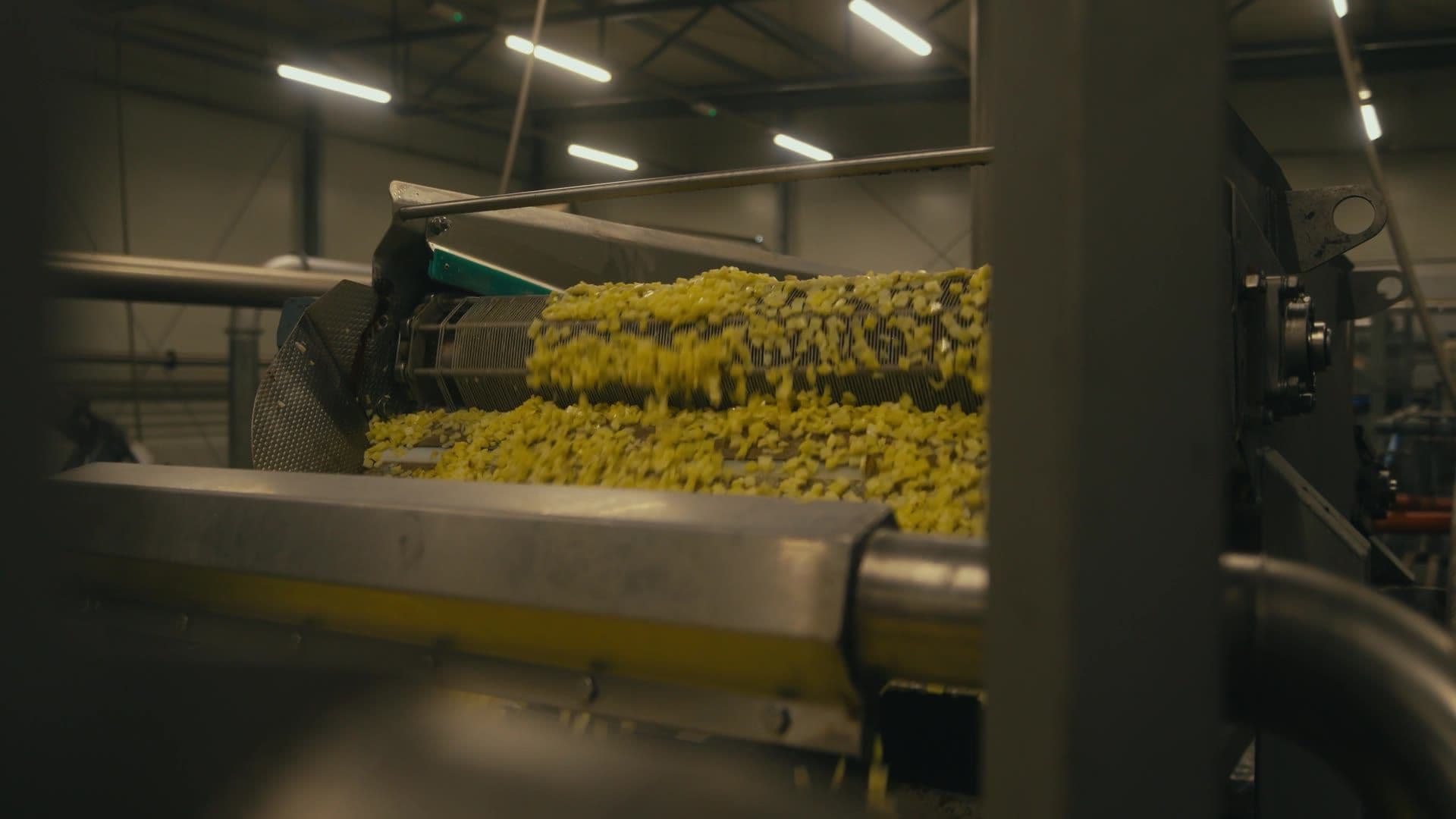
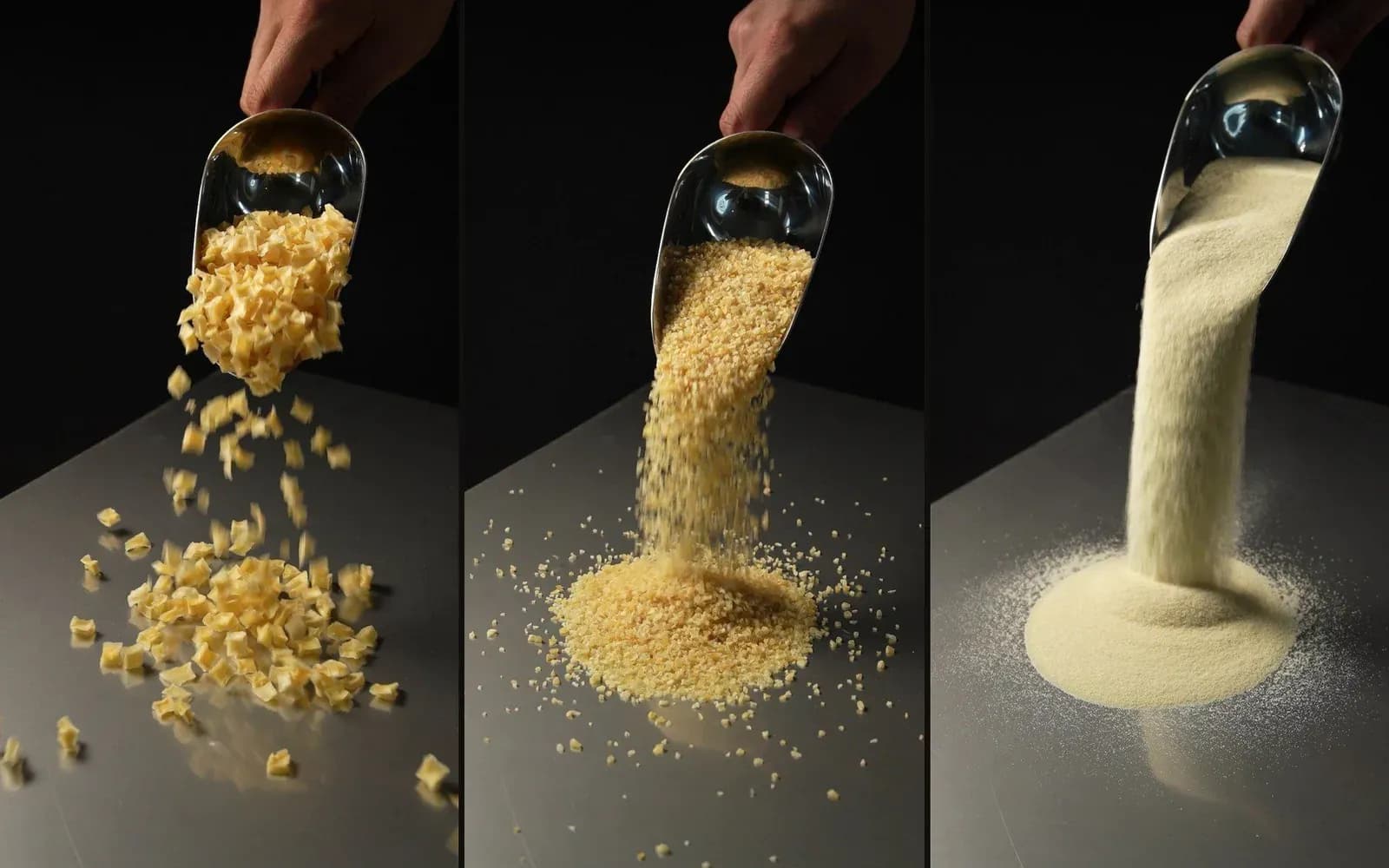
Cutting. The tuber is cut to its target shape: cubes of 10×10×7 or 10×10×2 mm, sticks of 15×2×2, 20×3×2 or 3×3×6 mm. Forms with a visible piece of potato end their journey here and go on to drying and packing.
Drying. Water leaves the pieces, and what remains keeps for 12 months from the production date in a closed pack, without refrigeration and without preservatives. The shelf life comes from reduced water content, not from additives.
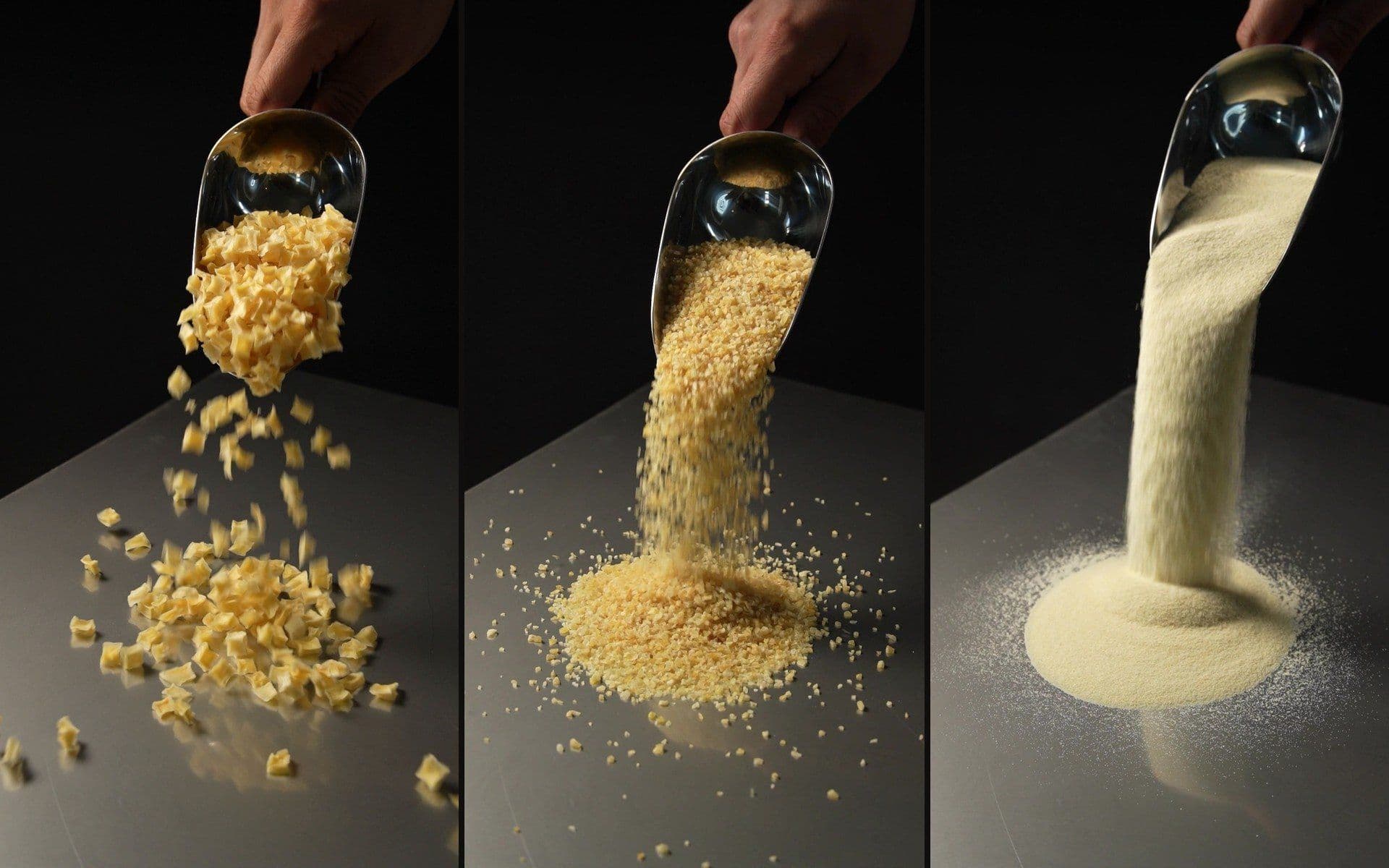
Milling and fractioning. Part of the dried material goes to the mill, where the fractions are made: grits 1.5-2.5 mm, semolina 0.01-1 mm, powder and granules 0.01-0.5 mm. The fraction is what a customer selects for their process - and what has to be identical in every batch.
Control and packing. Every batch is tested before dispatch and the results are provided in the batch certificate of analysis. Products are packed in paper bags of 10, 15 and 25 kg or in big bags, compliant with Regulations (EC) No 1935/2004 and (EU) No 10/2011. A pallet of 120×100 or 120×80 cm takes a maximum of 1000 kg.
Why production runs 12 months a year
The potato is a seasonal raw material; dried potato does not have to be. ECOCORE processes the crop continuously through the year, which gives purchasing two things: availability - the same product in March and in October - and a contract price that does not depend on the month you call. The details are in the guide Water binding in fillings and meat products with potato.
For a product developer it means one more thing: the same fraction and the same raw material in consecutive deliveries, so an approved recipe does not need adjusting batch by batch.
What one raw material becomes
| Line | Products | Applications |
|---|---|---|
| Dehydrated potato | cubes, sticks, grits, semolina, powder, granules | ready meals, bakery, masses, fillings, snacks, toppings |
| Instant potato products | 7 mixes: mashed potato, pancakes, dumplings, gnocchi and more | foodservice, catering, retail |
| Petfood Premium | dried potato 0.01-1 mm | dry and wet pet food, BARF |
Fourteen products from a single raw material. The company history - founded in 2013, plant in Przykona since 2015 - is on the about ECOCORE page.
What the sequence means for a recipe. Three practical consequences. First: dried potato binds more water than a flake, because it carries the whole potato rather than gelatinized starch alone - hence the water adjustment when switching. Second: the fraction is chosen, not inherited; potato powder gives a smooth mass, potato grits 1.5-2.5 mm a visible particle in bread and coatings, and potato granules controlled uptake in extrusion. Third: the ingredient list stays at one entry, so your own label does not grow. Selection by industry is described on the application pages, for example dehydrated potato for bakery. We go into more detail in the guide Rehydrating dehydrated potato dices.
Certification covering the process
The plant holds IFS Food at Higher Level (scope: production of potato granules and packing). Organic items carry a TÜV Rheinland Polska certificate under Regulation (EU) 2018/848, and the range is certified kosher (Strictly Kosher, Pareve). The plant accepts supplier audits and technical visits, notified at least 20 working days in advance. A separate guide covers Gnocchi dough from potato semolina.

Frequently asked questions
The potato is cut, dried and - except for cubes and sticks - milled into fractions. Unlike flake production there is no cooking before drying, so the composition stays at one entry: 100% dried potato, with no preservatives, emulsifiers or SO₂. Six forms come out of that process, from 10×10×7 mm cubes to 0.01 mm granules, and production runs 12 months a year.
In our plant that is exactly what happens: raw potato is cut into pieces and dried, and only afterwards milled into the finer fractions. There is no cooking step before drying, which is what keeps the ingredient list at a single item. The alternative route, cooking and drum-drying the mash, produces flakes, and that is a different material with a different ingredient list.
Not for this material. Flake production cooks the potato before drying, which is why flake ingredient lists often carry emulsifiers or antioxidants. We dry cut pieces and mill them afterwards, so no stabilisers are needed and the composition is one entry: potato. The 12-month shelf life comes from the reduced water content rather than from additives.
Flakes are cooked and dried on a drum, which is why their ingredient lists often carry emulsifiers or antioxidants. We dry cut pieces and mill them afterwards, so no stabilizers are needed and the composition stays at one item. Powder and granules replace flakes 1:1 in a recipe, at the same dosing stage, with the water adjusted after the first trial.
No. We process raw material continuously, 12 months a year, so the same item is available in March and in October and the contract price does not depend on the month of the enquiry. The standard lead time is 14 days and the minimum order is one bag. For a technologist that means the same fraction in consecutive deliveries.
From our own contract growing with farmers and from purchases on the open market throughout the year. Each batch number is linked to a supplier and an intake date, and the batch number appears on every bag label, so the route from field to bag can be traced back. Details are on the potato purchasing page, and the traceability description is part of the qualification package.
Yes - the plant accepts supplier audits and technical visits. Please notify us at least 20 working days before the date; requests are handled by Marcel Rosiak (marcel@ecocore.pl) and Krzysztof Wroński (krzysztof@ecocore.pl). Before the visit it is worth putting together the list of items and what your procedure needs from the documents, so the audit closes the qualification in one round.
Because the pieces are dried first and milled afterwards, so there is nothing to stabilise: the ingredient list of the dehydrated line has a single entry, potato, with no preservatives, emulsifiers or sulphur dioxide. The 12-month shelf life comes from the reduced water content, and the status of a particular item is confirmed by its specification, sent by e-mail on request.
Want to see how dried potato behaves in your recipe? Request a free sample - we will send the selected fractions together with the specification.