Why the mass is repeatable
Dough made from fresh potatoes changes twice over: with the variety and with standing time. Riced potato releases water as it stands, so dumplings made at the start of a shift behave differently from those made at the end. Dehydrated potato removes both variables, because water is added rather than squeezed out.
Three things follow in production: the mass can be shaped in advance, because it does not release water onto the tray; it does not darken and keeps a light colour throughout the process; and it behaves the same in January and in July, because starting moisture is a parameter of the item rather than of the weather.
The composition is a single entry: 100% dried potato (Solanum tuberosum), with no preservatives, emulsifiers or SO₂. The recipe contains no allergens from Annex II to Regulation (EU) No 1169/2011 - in masses and fillings that shortens the label of the finished product.
Fraction by dish
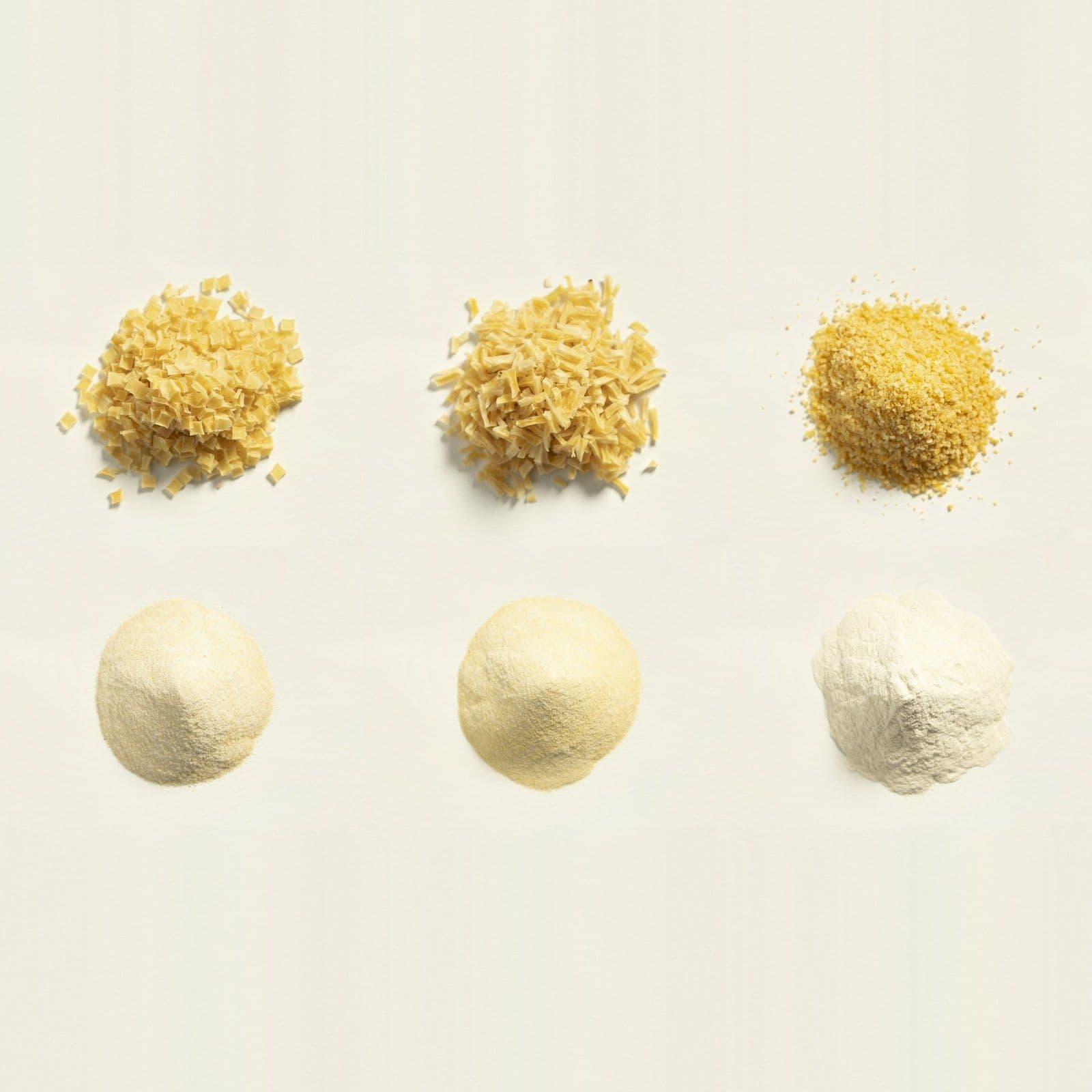
Potato semolina covers fractions within 0.01-1 mm - five ranges to choose from, bulk density 860 g/l at 0.01-1 mm. The coarser the grain, the more pronounced the texture of the finished product.
| Dish | Product | Fraction |
|---|---|---|
| Dumpling dough and filling | semolina or powder | 0.01-1 mm |
| Potato noodles | semolina | 0.01-1 mm |
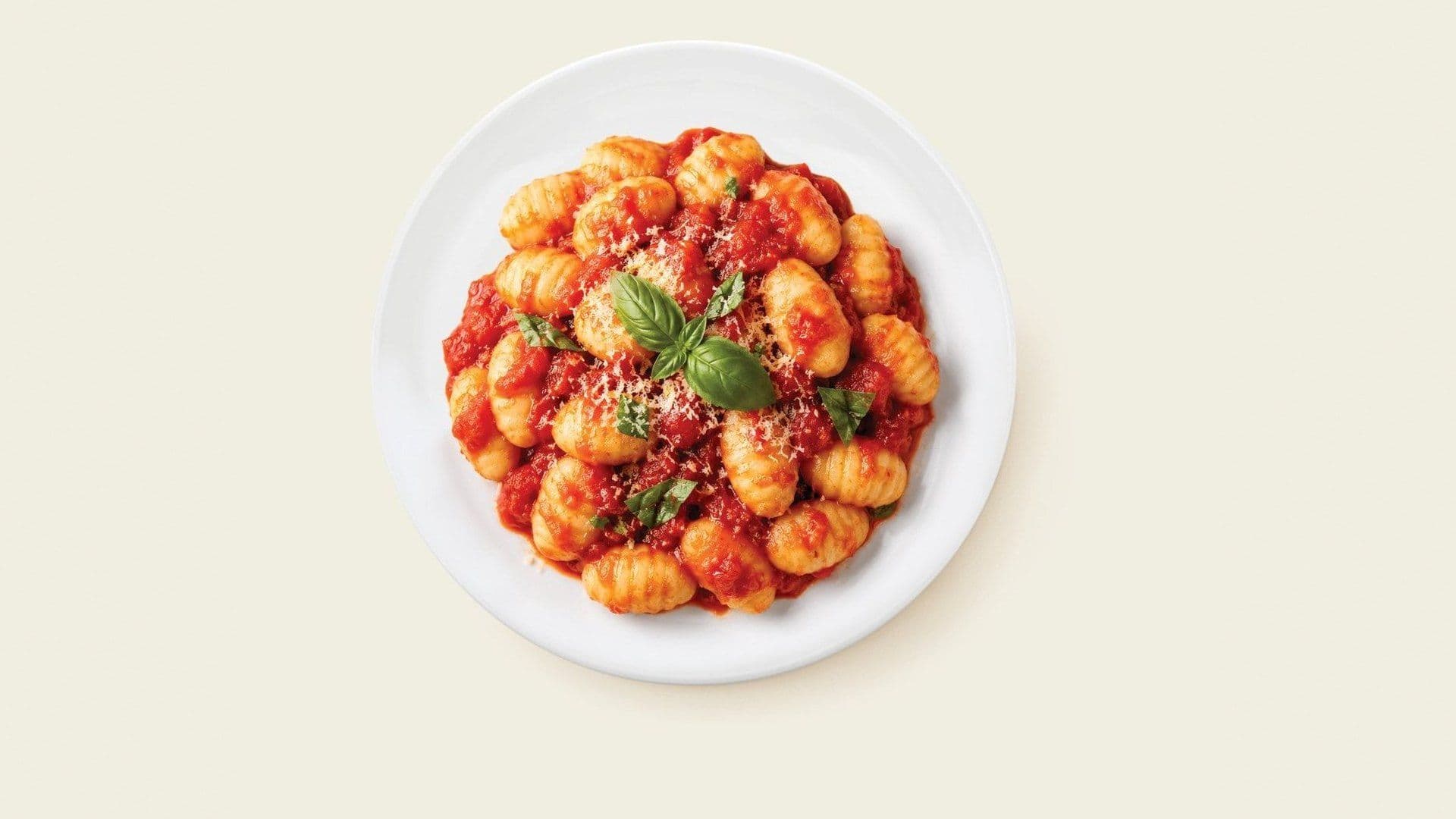
| Gnocchi | semolina | 0.1-1 mm |
| Silesian dumplings | semolina | 0.5-1 mm |
| Potato dumplings | semolina or powder | 0.5-1 mm |
| Smooth filling | powder | 0.01-0.5 mm |
| Textured filling, croquettes | semolina | 0.01-1 mm |
The rule is simple: potato powder gives a smooth dough and a smooth filling, semolina gives a noticeable potato texture. When the choice is close we send both fractions for the same recipe; it is confirmed by a technologist in a trial, usually with two fractions at once. The full table is on the dumplings and gnocchi page.
How much water goes into the mass
For your own recipe we do not publish a single water figure, because it depends on what the mass has to do: dumpling dough, filling and noodle dough bind water differently. The hydration parameters of an item are in its specification, and the starting point is set by a technologist once the process is described.
Two figures are fixed, though, and work as reference points. First, potato granules bind water indicatively up to 1:4.5, so 1 kg and 4.5 l of water give about 5.5 kg of product (for flakes, in the example analysed, 1 kg and 4 l gave about 5 kg). Second, the ready instant mixes built on the same base state their ratios directly: gnocchi 200 g of mix to 500 ml of water, potato dumplings 309 g to 750 ml, both with 10 minutes of resting.
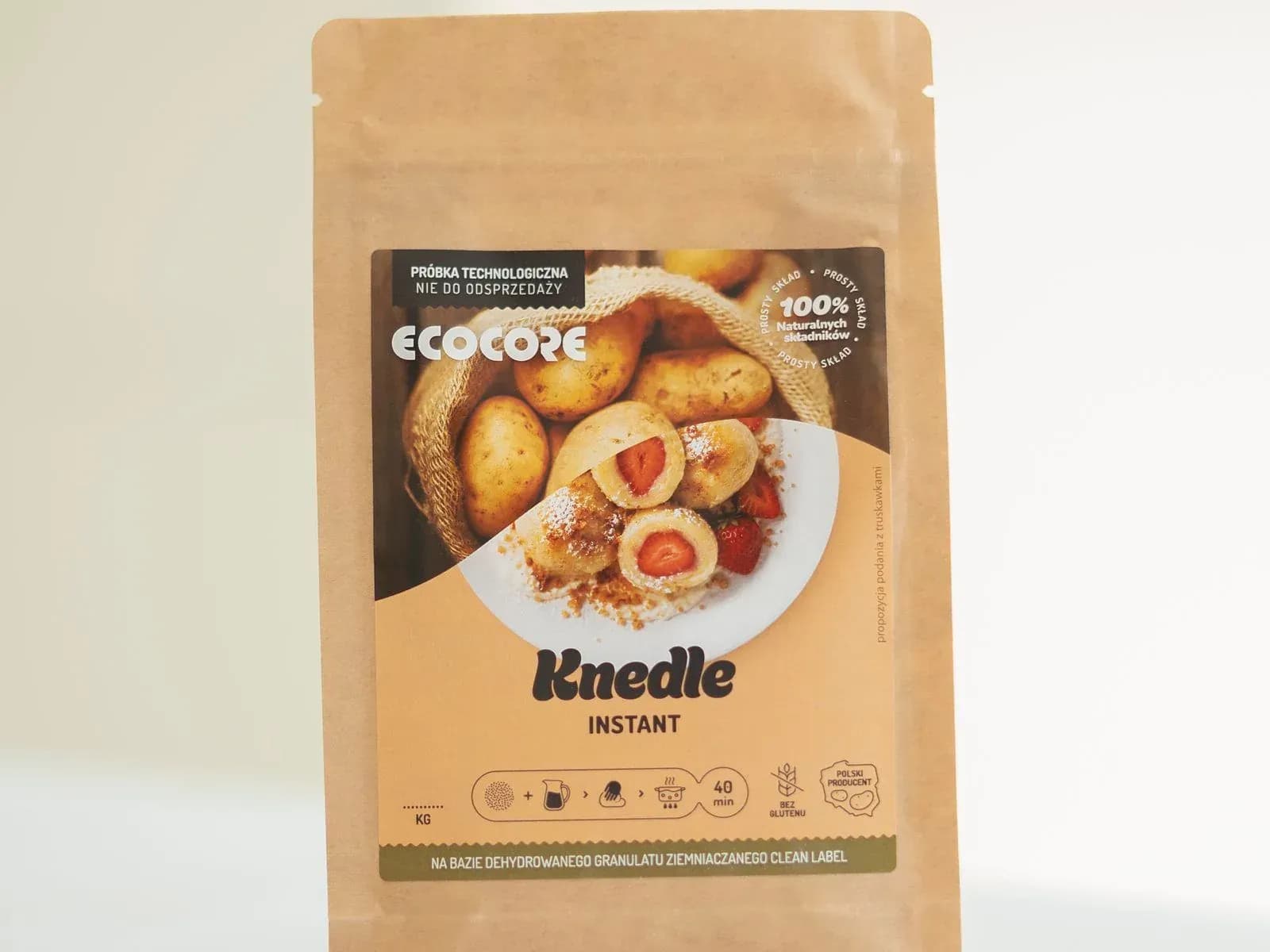
If you are starting from scratch, a ready mix is the quickest way to see how a dehydrated-potato mass behaves; how it differs from flakes is covered in What are potato flakes. The details are in the guide Fresh or instant mashed potato.
Where it changes how work is organised
In a plant that boils potatoes the day before, changing the raw material affects not only the recipe but the schedule. Boiling, cooling and ricing disappear, and with them the occupied kettle, the chilled space for the mass and the time window in which it has to be used.
In catering it shows most at portioning: the mass is made up in batches the size of one pot load rather than all at once, because shaped pieces wait better on a tray than finished mass in a bowl. In industrial production what counts is that dosing dehydrated potato is repeatable whether gravimetric or volumetric - volumetric dosing only needs the bulk density of the chosen fraction, because between 0.01-1 mm and 0.5-1 mm it differs enough to change the mass in the hopper. We go into more detail in the guide Water binding in fillings and meat products with potato.
A separate benefit concerns the store: semolina is dry, keeps for 12 months from the production date and needs no refrigeration, so raw material stock no longer competes with semi-finished goods for chilled space.
The trial on your own line
- Describe the process and the volume. The technologist names the fraction and the starting parameters instead of pointing at a catalogue.
- Run a reference batch with the current raw material, on the same day and the same shift.
- Run the trial batch - dehydrated potato in place of the current material, at the same dosing stage.
- Assess both side by side: behaviour during shaping, shape retention after cooking, texture at the cut, colour after a few hours of standing.
- Adjust the water and record it in the trial protocol.
For frozen production one more step applies: masses made from dehydrated potato withstand freezing and thawing well, but parameters for a specific line are confirmed in a trial, because the freezing method and the packaging also matter. A separate guide covers Potato bread.
Frequently asked questions
You make gnocchi dough from potato semolina by hydrating the semolina with water, letting the mass stand and then shaping it, with no boiling, cooling or mashing of potatoes. The starting water ratio depends on the product and is given in the item specification; the final ratio is set by a technologist in a trial. The mass keeps its light colour throughout the process, so it can be shaped in advance.
Gnocchi dough is made of potato, flour and usually egg; in our version the potato part comes from potato semolina of 0.01-1 mm instead of boiled potatoes. The semolina has a single entry in its composition: dried potato. For a ready instant mix the proportions come straight from the data sheet, where 200 g of mix and 500 ml of water give about 70 gnocchi.
In the simplest recipe yes, with egg as the third ingredient, and the balance between potato and flour is what decides the texture. Working from potato semolina removes one variable, because the composition is the same in every batch whatever the variety or season. The flour share and the water stay with your recipe, and the final ratio is confirmed in a trial.
Powder gives a smooth dough and a smooth filling, semolina a noticeable potato texture. Powder covers 0.01-0.5 mm, semolina 0.01-1 mm, and both have one entry in the composition. The choice is confirmed in a trial, usually with two fractions at once on the same recipe, because the difference shows on the line rather than in the data sheet.
No - unlike a mass from fresh potatoes it keeps its light colour throughout the process, because the raw material is already dried and the enzymes that drive darkening are gone. That is why the mass can be shaped in advance, which changes the order of work on the line. Parameters for your own process are confirmed in a trial.
The starting point depends on the product and is stated in the item specification; the final ratio is set by a technologist in a trial on your own line. For ready instant mixes the ratios come straight from the data sheet, for example 309 g of mix to 750 ml of water for potato dumplings. After the first trial the water is usually the only parameter that needs resetting.
Yes - masses made from dehydrated potato withstand freezing and thawing well, and they keep their light colour through the process. Parameters are confirmed in a trial on your own line, because the freezing method and the packaging also matter. The composition is the same in every batch, so the result does not move with the variety or the season.
Describe the dish and the volume and a technologist will pick the fraction - request a free sample of two neighbouring fractions and compare them on the same mass.