Why granules rather than any fraction
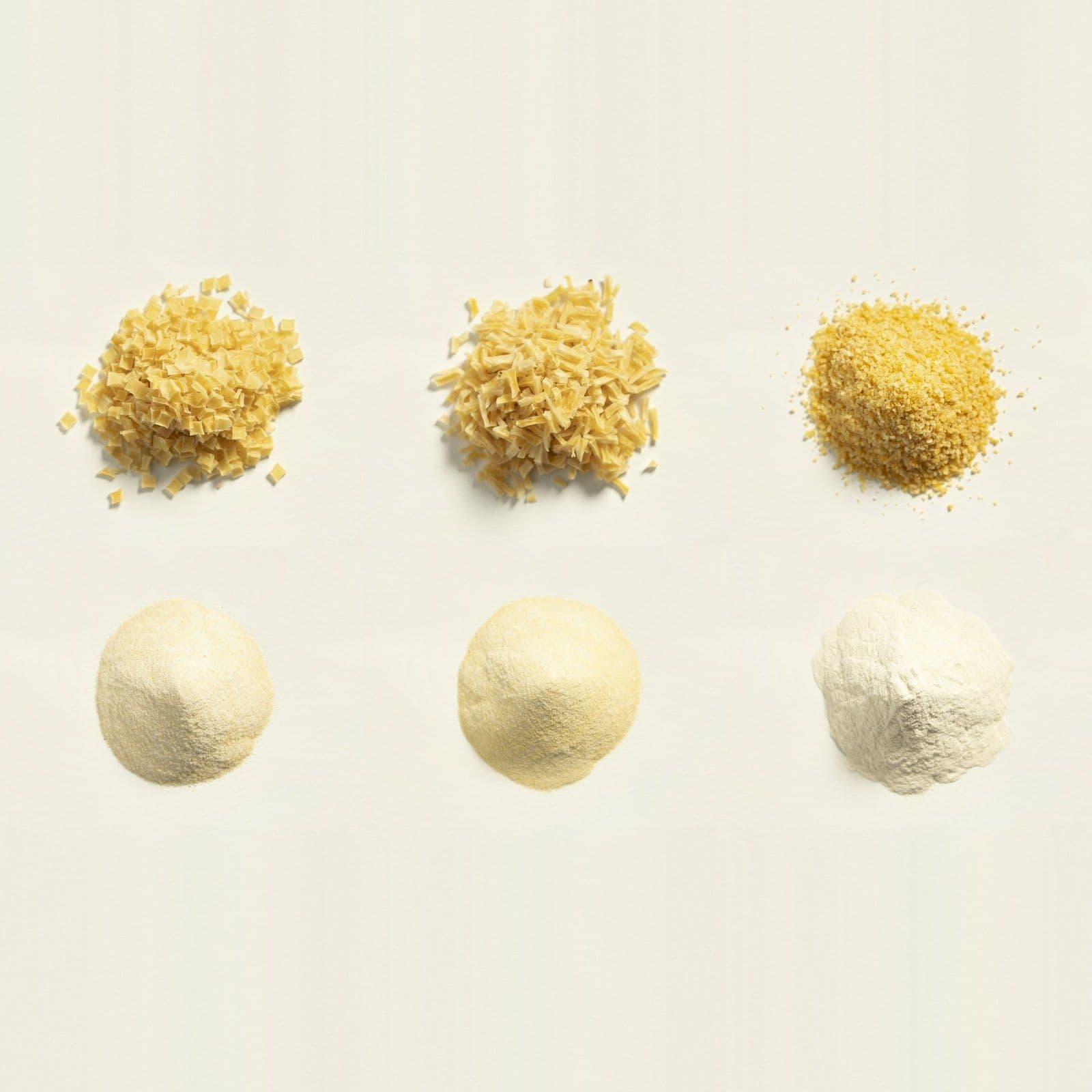
Potato granules are the first choice in extrusion because there are five fractions within 0.01-0.5 mm - which lets you tune water absorption to a specific line instead of adapting the line to the material.
| Product | Form | Starting fraction |
|---|---|---|
| Pellets for extrusion | granules | 0.01-0.1 mm · 0.01-0.25 mm |
| Extruded snacks | granules | 0.01-0.5 mm (of five fractions) |
| Flake replacement in a recipe | granules or potato powder | 0.01-0.5 mm |
Bulk density moves with the fraction: 0.01-0.1 mm is 860 g/l, 0.01-0.25 mm 870 g/l, 0.01-0.5 mm 930 g/l, 0.1-0.5 mm 825 g/l and 0.01-0.125 mm 760 g/l. Where dosing is volumetric that difference shows up directly in the mass in the hopper, which is why a specification always states the fraction next to the product name.
Granules are also the form in which potato flavour stays noticeable in the finished product, so they appear in snack recipes for more than technological reasons. The full description and the selection table are on the dehydrated potato for snacks and pellets page, and the comparison of all six forms is in What are potato flakes.
Water absorption: the figure you start from
Granule absorption is indicatively up to 1:4.5 - 1 kg of granules and 4.5 l of water give about 5.5 kg of product. For potato flakes, in the example analysed, 1 kg and 4 l gave about 5 kg. That difference is exactly why, after swapping flakes for dehydrated potato, you adjust the water rather than the recipe: the material goes in 1:1 at the same dosing stage, and that is usually the only parameter to change. We go into more detail in the guide Glossary of dehydrated potato terms.
We do not publish expansion, pressure or temperature profile parameters, because they belong to your line rather than to the material - two extruders run the same granules differently. What can be said about the material is in the specification: fraction, bulk density, composition, moisture and hydration parameters.
The 1:1 trial on an extrusion line
- Describe the recipe and the line. The technologist names a starting fraction - for pellets usually one of the two finest - and sends two fractions where the choice is not obvious.
- Run a reference batch with the current material, on the same day and the same shift.
- Run the trial batch - granules in place of flakes, 1:1 dosing, the same stage.
- Record line parameters for both batches: mass moisture before the die, pressure, motor current, pellet appearance after drying and after expansion.
- Adjust the water and repeat the measurement - both runs go into the trial protocol.
The most common mistake in a first trial is carrying over the water quantity from the flake recipe unchanged. The mass comes out too wet, and the verdict "granules do not work" is reached before anyone changes a single parameter. The second typical mistake is judging after one run: the line needs a few minutes on the new material to stabilise mass moisture and pressure.
What to measure on the first batch
Four figures are enough to keep the next batch from being guesswork. Mass moisture before the die shows fastest whether the water correction was sufficient. Pellet density after drying, measured the same way for both batches, says more than visual assessment. Yield per kilogram of material - the 1:4.5 conversion is the starting point, and the value recorded on the trial batch is what goes into costing. Behaviour after expansion - crispness, colour and uniformity, judged at the same interval after the line.
What stays the same after the swap
The composition remains one entry: 100% dried potato (Solanum tuberosum), with no preservatives, emulsifiers or SO₂; the recipe contains no allergens from Annex II to Regulation (EU) No 1169/2011. In snacks, where the label is short, that is a real difference from compound preparations. A separate guide covers Potato flour substitute.
The rest applies across the line: shelf life of 12 months from production in closed packaging, storage in a dry room up to 30 °C at a recommended relative humidity of 75%, paper bags of 10, 15 and 25 kg or big bags - for continuous production with discharge from a hoist, usually big bags. Orders from a single bag, standard lead time of 14 days and production 12 months a year, so the contract price does not depend on the month you ask.
Every batch is tested before dispatch and the results come in the certificate of analysis; the batch number carries the raw material supplier and the intake date, so traceability back to the field is available to a snack producer with its own documentation duties.
Frequently asked questions
Potato snack pellets are half-products: a dried, formed mass that expands into a snack during frying or hot-air expansion. The mass is made from dehydrated potato, water and the rest of your recipe, extruded and cut to shape. ECOCORE supplies the raw material for that mass, potato granules in five fractions within 0.01-0.5 mm, with a single entry in the ingredient list: potato.
Potato pellets are made of dehydrated potato, water and whatever else your recipe calls for, most often starch and seasoning. In our part of it the composition stays at one item: dried potato, with no preservatives, emulsifiers or SO₂. Granules bind water in a constant ratio, so the dosing of the mass does not drift between batches, and the parameters of each batch are given in the specification.
For pellets the finest ranges are the starting point: 0.01-0.1 mm and 0.01-0.25 mm out of five available within 0.01-0.5 mm. The choice depends on the recipe and on the line, so we confirm it in a trial, usually with two fractions at once on the same recipe. Bulk density is 825 g/l, which matters when the dosers are set volumetrically.
In extrusion potato granules absorb water up to roughly 1:4.5: as a guide, 1 kg of granules and 4.5 l of water give about 5.5 kg of mass. Flakes in the example analysed bind 1:4, so 1 kg and 4 l give about 5 kg. The exact ratio for your recipe is confirmed in a trial, and the batch values are given in the specification.
Yes - granules and powder go in 1:1 in place of flakes, at the same dosing stage and with no process change. Only the water changes, and the technologist adjusts it after the first trial. The ingredient list keeps a single item: potato. For a new product your own recipe approval process decides how many trials are needed.
No, because expansion parameters depend on the line rather than on the material. We provide the material parameters from the specification: fraction, bulk density, composition and hydration, plus the batch certificate of analysis. Extruder settings, temperature profile and die geometry are established in the trial on your own line, and our technologist works through that trial with you.
On the first batch it is worth recording the water added to the mass, the moisture of the pellet before drying, and the expansion of the finished snack against your reference batch. That is enough to see whether only the water needs adjusting or whether a different fraction is the answer. Keep the batch number from the bag label with the measurement, so the result can be traced back.
Describe the line and the recipe and a technologist will name the starting fraction - request a free sample of two granule fractions and compare them in a single run.