Three size ranges and what follows from them
Every milled form is made the same way: the potato is cut, dried and only then milled. Each is 100% dehydrated potato (Solanum tuberosum), with no preservatives, emulsifiers or SO₂, and the fraction is identical in every batch. The difference starts with particle size.
| Range | Product | Fractions | Bulk density | Role in the recipe |
|---|---|---|---|---|
| 0.01-0.5 mm | potato powder | 4 | 825-930 g/l | smooth mass, 1:1 flake replacement |
| 0.01-0.5 mm | potato granules | 5 | 760-930 g/l | controlled water absorption in extrusion, 1:1 flake replacement |
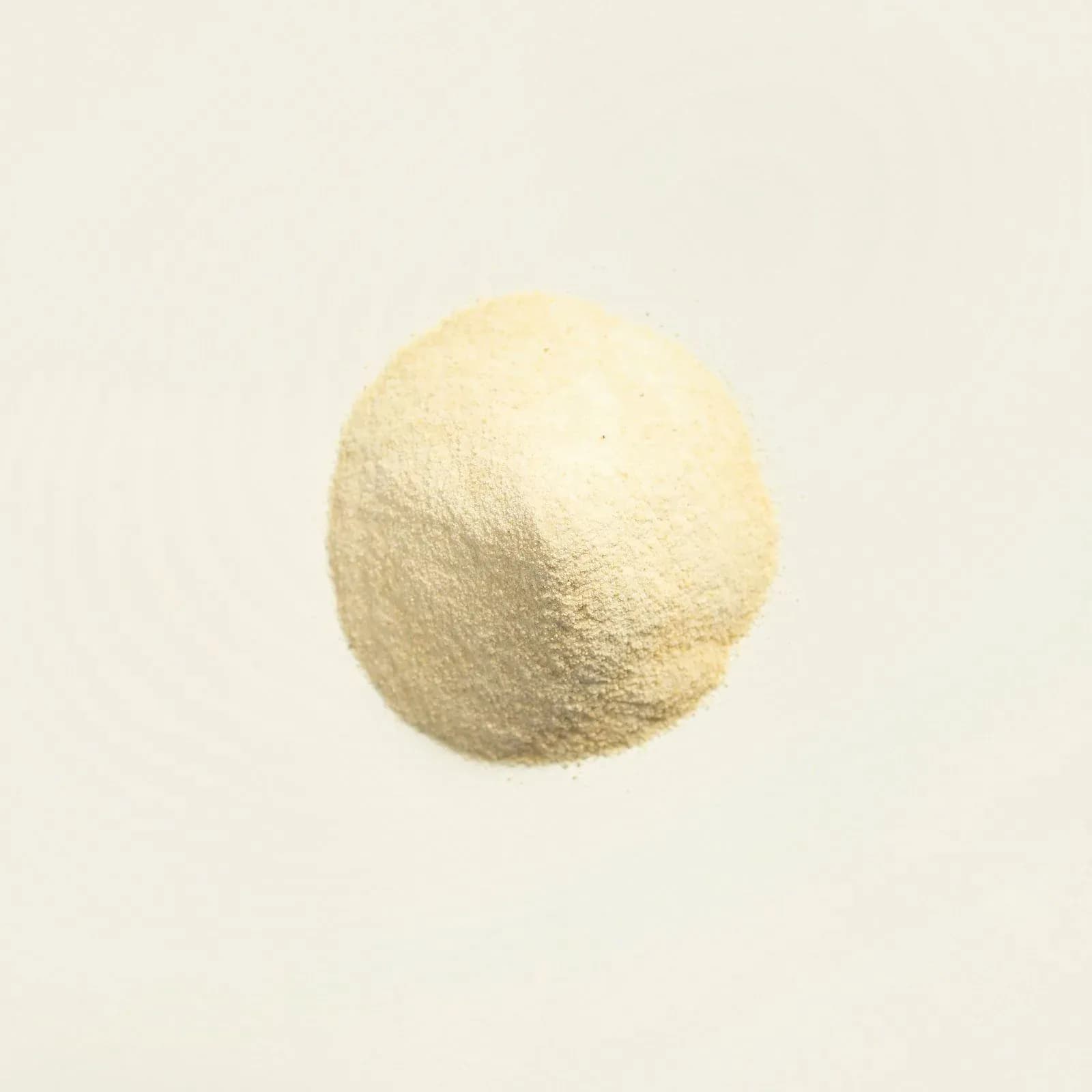
| 0.01-1 mm | potato semolina (fine grits) | 5 | 750-930 g/l | mass with a noticeable grain |
| 1.5-2.5 mm | potato grits (coarse) | 1 | 670 g/l | visible speck in bread, coatings and toppings |
Bulk density depends on the fraction within a product: powder at 0.01-0.5 mm is 930 g/l, while 0.1-0.5 mm is 825 g/l. Wherever dosing is volumetric that difference translates directly into the mass in the hopper, which is why a specification always states the fraction next to the product name.
The forms that are not milled - cubes at 10×10×2 and 10×10×7 mm and sticks at 15×2×2, 20×3×2 and 3×3×6 mm - are described by dimensions rather than by fraction. Their selection is driven by the shape of the piece on the plate, not by particle size.
Four questions that narrow the choice
What is being dosed today? If it is potato flakes, we start with powder or potato granules: both enter the recipe 1:1 at the same dosing stage, and only the water is adjusted. Granules bind water indicatively up to 1:4.5 - 1 kg of granules and 4.5 l of water give about 5.5 kg of product.
Should the grain be visible after processing? In a potato roll, yes - hence coarse potato grits at 1.5-2.5 mm, whose particles stay visible after baking. In a moist bread, no - hence powder up to 0.5 mm, which binds water without changing the crumb. The details are in the guide Rehydrating dehydrated potato dices.
Is the mass formed or extruded? Doughs for dumplings and gnocchi work with potato semolina or powder; pellets and extruded snacks with granules, where five fractions within 0.01-0.5 mm let you tune water absorption to a specific line.
Is dosing gravimetric or volumetric? Volumetric dosing needs the bulk density of the chosen fraction; gravimetric dosing does not.
A technologist asks these four questions at the start of a conversation. They do not replace the trial, but they shorten it to one production day: instead of working through the whole 0.01-2.5 mm range, you test two options next to a reference batch.
Particle size by application
| Application | Product | Fraction |
|---|---|---|
| Potato rolls | coarse grits | 1.5-2.5 mm |
| Moist potato bread, white bread | powder | 0.01-0.5 mm |
| Dumpling dough and filling | semolina or powder | 0.01-1 mm |
| Gnocchi | semolina | 0.1-1 mm |
| Potato dumplings, Silesian dumplings | semolina | 0.5-1 mm |
| Smooth fillings | powder | 0.01-0.5 mm |
| Textured fillings, croquettes | semolina | 0.01-1 mm |
| Coatings, seasoning blends | coarse grits | 1.5-2.5 mm |
| Toppings | coarse or fine grits | 1.5-2.5 mm · 0.01-1 mm |
| Thickeners | powder or semolina | 0.01-0.5 mm · 0.01-1 mm |
| Pellets for extrusion | granules | 0.01-0.1 mm · 0.01-0.25 mm |
| Extruded snacks | granules | 0.01-0.5 mm |
The tables come from the application pages for the individual industries. They are a starting point; the final fraction is confirmed by a technologist in a trial. We go into more detail in the guide Gnocchi dough from potato semolina.
Why particle size is settled in a trial
Between two neighbouring fractions the difference is often invisible on paper and obvious in the mass. That is why, when the choice is close, we send two fractions for the same recipe - cheaper than one delivery that misses. Samples are free once agreed with sales, dispatch takes at most 5 working days, and the parcel carries the specification and the technologist's contact details.
The sequence is always the same: a reference batch with the current raw material runs next to the trial batch, on the same day and the same shift, and then the water is adjusted. The sheet for recording results is the 1:1 trial protocol. A separate guide covers how private label works.
Whatever the fraction, the rest stays the same: shelf life of 12 months from production in unopened packaging, storage in a dry room up to 30 °C at a recommended relative humidity of 75%, paper bags of 10, 15 and 25 kg or big bags, orders from a single bag, and production 12 months a year.
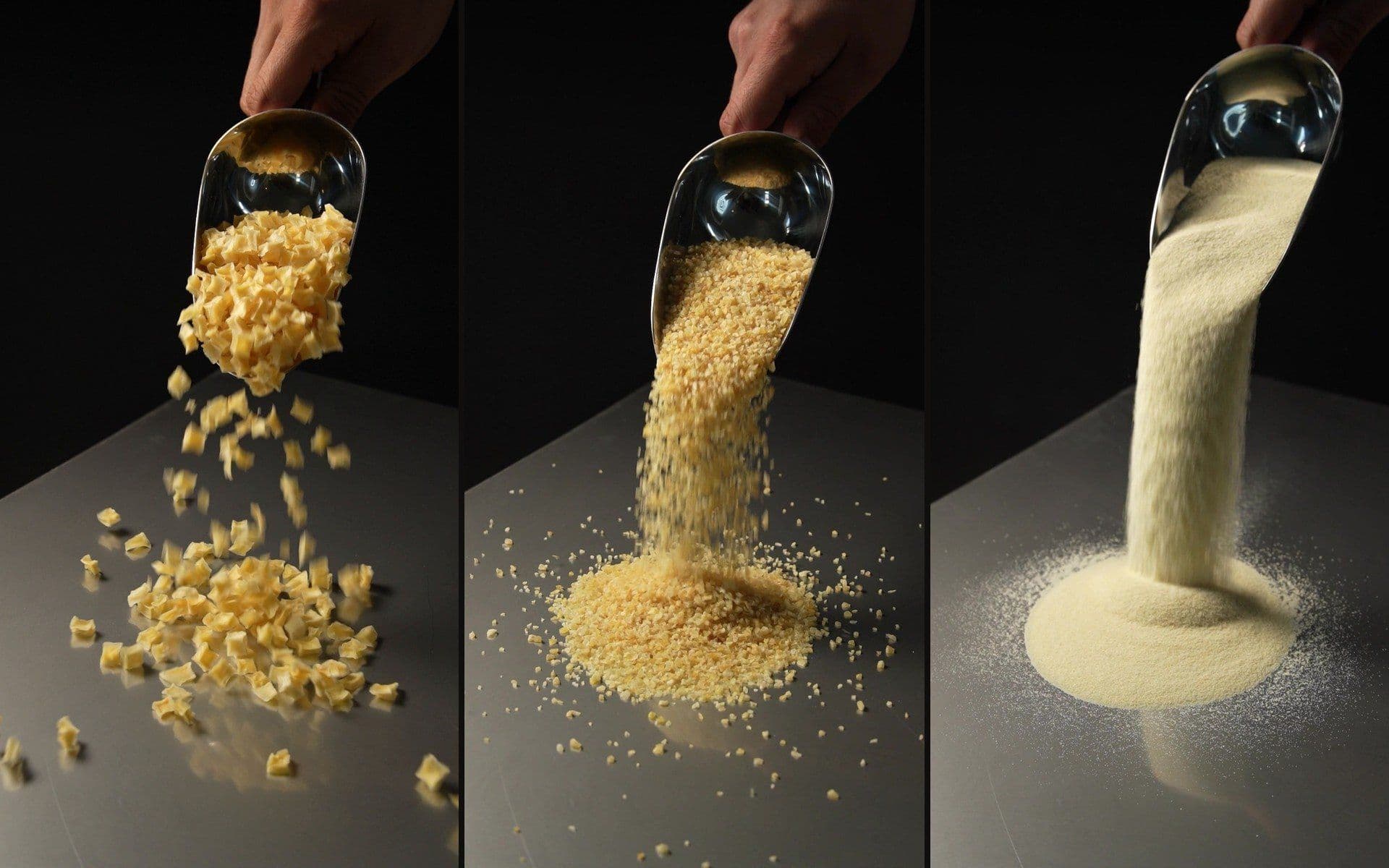
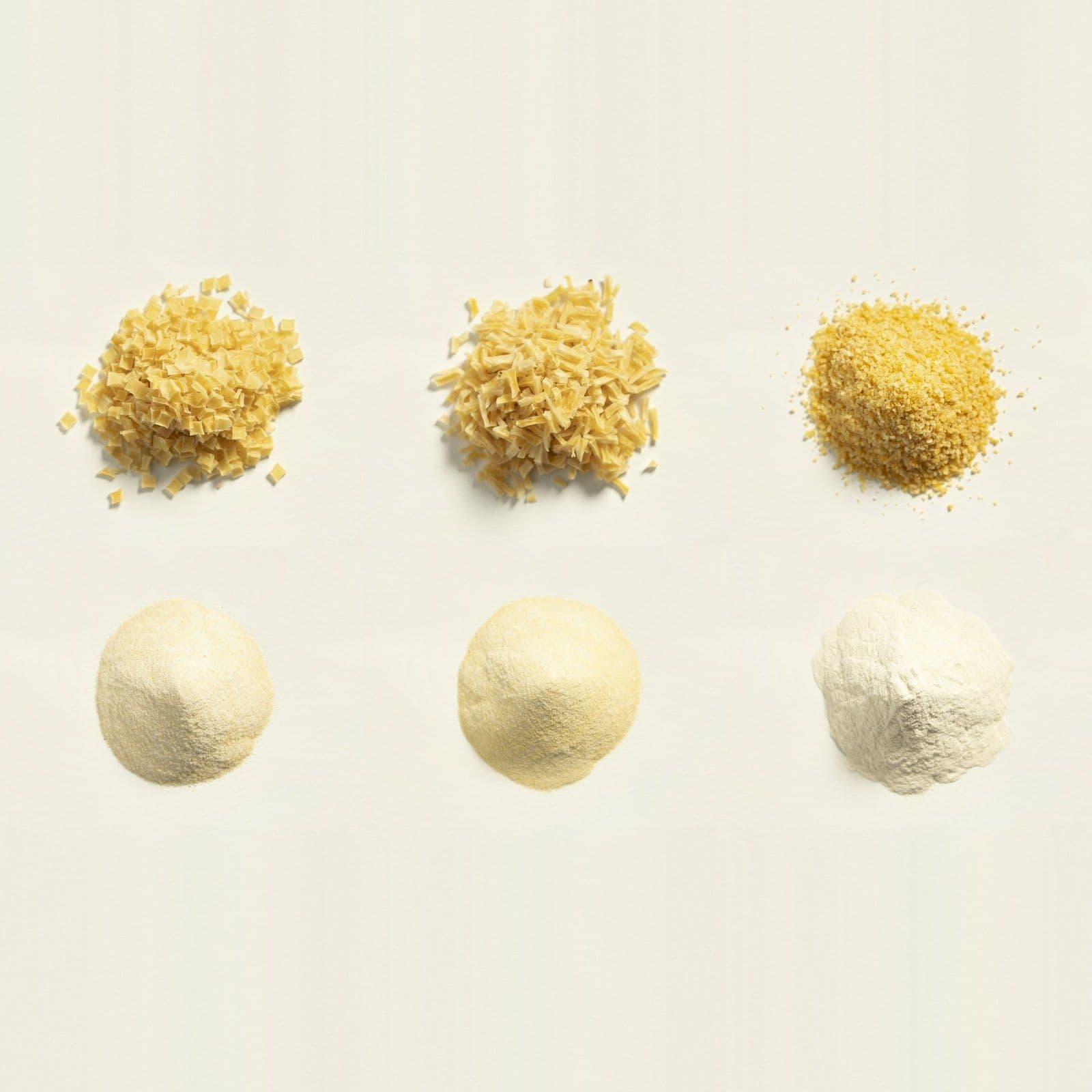
Six forms of dehydrated potato side by side, in open jars.
Frequently asked questions
The particle size, or fraction, is the range of particle diameters in a given item, from 0.01 mm granules to coarse grits of 1.5-2.5 mm, with cubes and sticks given as piece dimensions. It is a parameter of the item, not of the batch, so it is identical in every delivery. The range for a specific item is given in the specification / TDS together with bulk density.
Choose it from three questions: whether a visible piece of potato should stay in the dish, which points to cubes or sticks; whether the mass has to be smooth or may carry a noticeable grain, which points to powder or semolina; and whether the material goes into extrusion, which points to granules. For bread, seasonings and coatings, coarse grits of 1.5-2.5 mm are the usual answer.
The fraction. Semolina covers 0.01-1 mm and is the mid size for masses with a noticeable texture, with a bulk density of 860 g/l. Coarse grits are 1.5-2.5 mm, the coarsest milled form, at 670 g/l, used in bread, seasonings, toppings and coatings. Composition and technology are the same in both: 100% dried potato, with no preservatives, emulsifiers or SO₂.
For pellets and extruded snacks the finest ranges are the starting point: 0.01-0.1 mm and 0.01-0.25 mm out of five available within 0.01-0.5 mm. The choice depends on the recipe and the line, so we confirm it in a trial, usually with two fractions at once. Granules bind water up to roughly 1:4.5, which is the figure to start the mass calculation from.
No. The fraction range is a parameter of the item and is identical in every batch, which is the point of buying a milled material rather than grinding it yourself. Each batch is tested before dispatch and you receive the results in the batch certificate of analysis. If a delivery behaves differently on the line, quote the batch number from the bag label and we will check it.
The dehydrated forms have an organic variant certified by TÜV Rheinland Polska under Regulation (EU) 2018/848, so powder, granules, semolina, coarse grits and cubes are covered. For instant mixes the organic version is available on request. The scope for a specific item is confirmed by the certificate together with the specification, and the certificate itself can be downloaded with no sign-in.
With volumetric dosing the figure that decides the setting is bulk density: 930 g/l for powder, 860 g/l for semolina, 825 g/l for granules and 670 g/l for coarse grits. The same volume therefore carries different masses depending on the fraction. Take the value from the specification / TDS before the first run, and confirm the setting on your own dosers in the trial.
When the choice is open we send two fractions on the same recipe, so the comparison happens on one production run rather than across two weeks. The usual pairs are powder against semolina for masses, and two granule ranges for extrusion. Samples are free once agreed with sales, dispatched within a maximum of 5 working days, and we do not limit the number of items.
Torn between two fractions? Describe the recipe and request a free sample - we will send both for the same bake or the same mass.